Advice, Flash Fiction, Magical Realism, Speculative Fiction

What is Flash Fiction?

If you’ve been writing for a while, you already know what flash fiction is, but if you’re somewhat new to writing, you may not have heard of this liberating form. Man, are you gonna love it! My students do!

Sheets of paper sit on a writing desk with a magnifying glass on top. Decorative.
Photo by cottonbro on Pexels.com

Flash fiction is very short fiction – between 50-750 words, and it goes by a few different names, micro-fiction and short-shorts. It embraces extreme compression and is a literary hybrid between a short story and poem. It tends to bend, explode and reinvent genres and most writing rules. As H.K Hummel and Stepnanie Lenox say in Short-Form Creative Writing: A Writer’s Guide and Anthology, it is “trangressive” by nature. Traditional story elements found in longer stories, such as complex character development and a series of reversals of fortune, don’t always apply to flash. Nevertheless, they have an internal logic that makes them tick, and when you miss that logic, they fall flat.

One of the reasons I love the form so much is that it forces you to put every word under the microscope to see if it’s really needed. A few years of writing and grading flash fiction has made me much more confident about editing longer works, including novels.

A great online journal to explore the form is Wigleaf (linked here). Every year, they pick fifty very short stories they consider the best of year (one of mine was picked in 2015).

Usually, the trick is to write about the last few seconds of an event, as Joanne Avallon does in “All This,” a copy of which can be found at this link, also anthologized in the text above, published by Bloomsbury. This story provides us with the anatomy of a moment’s revelation when a woman’s three-year-old bites her and she slaps the child. Between the hand drawing back and the hand hitting the child, so much happens, and yet the whole thing is only 244 words — less than a page.

The most common mistake students make when attempting flash is to try to cram too much into the short form, resulting in bland summary. Nevertheless, it can be done if you use the fable form, as we see in the story “Row” by Charmaine Wilkerson, available here, about how a civilization responds to climate change. The story is only 100 words. The reason it works is that it uses third person plural, in which the people go from minor to major denial, and it uses just the right amount of concise detail: they “eat cactus and fried lizards” and they “tie their rowboats to the higher branches.”

Another exciting thing about the form is that experimentation appears to be inherent. Lydia Davis, who said she could never master the conventional short story form, found liberation in flash fiction. All those things you’ve written in which you can’t quite identify the problem — or don’t quite know how to turn into a short story– turn out to be great flash fiction. A great example of an experimental form is “Three Ways of Saying the Same Thing” by Leonora Desar. It is just what it says it is, three paragraphs, each with their own subtitle, that talk about states of non-being, but which also employ surrealism or fabulsm (also called magic realism), as we see from the first line: “One day my boss was talking to me and I just disappeared.”

So, I hope you enjoy this brief introduction and dip your toes in soon.

Processing…
Success! You're on the list.
Advice, Literature, poetry

Are You a Poet or a Fiction Writer? Does it Matter?

People used to tell me I was really a poet, not a fiction writer because I tended to focus more on wording than plot. I disagreed. For one thing, I was afraid of poetry and had always preferred to read stories. Years later, after much writing, reading, and teaching, I’ve learned a lot about plot and character development, and I’m no longer afraid of poetry either, as I explain in this Tiktok video.

I tend to like more accessible poets, but if they’re too accessible, they don’t reverberate- which is one of the best properties of poetry. “Reverberate” is my word for when you keep finding more layers of meaning as you go over it. I liken poetry to a riddle. It’s like playing scrabble or chess. You want it to give you something to unravel, but you don’t want to be totally left out in the cold.

It’s hard to teach poetry, because it’s so darn subjective, but I believe I’ve come up with some good general rules: It should be compressed, it should make leaps of association, it should shift in some way (for example, from inside to out, from past to present, from abstract to concrete), it should make meaningful use of line breaking, it should appeal concretely to the senses, and it should be original. The parameters are broad intentionally.

I have a fondness for Wallace Stevens, even though he can be pretty abstract. I’ve found that it’s easier to understand a poet if you read a lot of their poetry all together, because you start to be able to crack their code. Memorizing poetry is another way to to understand a poem, and it has the added benefit of being good for your brain and making you seem super erudite (not that we need to try, right?

I have a terrible memory, so it took me a while to memorize Wallace Steven’s “Final Soliloquy of the Interior Paramour.” Making a tiktok out of it was the clincher.

@literarylatte

“The Final Soliloquy of the Interior Paramour” by Wallace Stevens. #poetrylover #booktok #professor #indiewritersoftiktok

♬ Night Trouble – Petit Biscuit

Summing up the meaning in a few sentences does it a disservice, so just take this as a conversation starter. The poem suggests our imagination is a powerful force, as powerful as that thing we call God. Yet sis poems “The Emperor of Ice Cream” and “Of Mere Being,” suggest he was an atheist, so poem seems to be suggesting that i wrapping ourselves in the beauty of poetry and the brilliance of a mind that puts itself to good use makes life worth living.

Sci-fi writer Ray Bradbury said he warms up for writing every morning by reading poetry first. You can tell by the poetic nature of his lines. Many writers write in more than one genre, but this isn’t well known because publishers think pigeonholing us makes us more marketable.

We don’t live to be marketable, and while I wouldn’t mind selling a few thousand copies of Strange Appetites, my book of short stories coming out in September and Blue Woman Burning, the novel coming out in December, I don’t write to be marketable, either. I write to be lifted by that candle Stevens talks about that lights the dark. I aim to blend a good plot with the best aspects of poetry. And my hope is that when you read my work, you too, are warmed by it and find that “being there together is enough.”

Processing…
Success! You're on the list.
Advice, Fantasy, Literary Criticism

What is Literary Fiction and Should it be a Requirement in Writing Workshops?

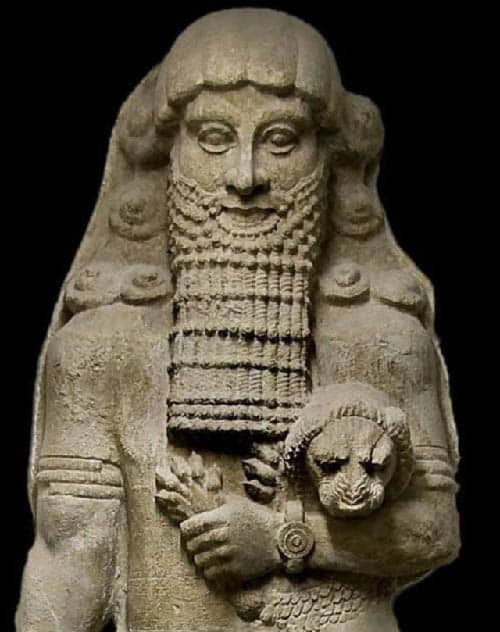
Epic_of_GilgameshThe first form of fiction was, arguably, fantasy, what with mythology going back to 4000BCE and the first written fiction, The Epic of Gilgamesh written circa 1200 BCE.  Some of the first English fiction  were also fantasy, such as Le Morte d’Arthur written c. 1470. Yet fantasy not still not considered “literary” merely because it’s fantasy.
Somewhere in the mid 1800’s, realism took over the halls of academe, and anything which took part in the fantastical was deemed “less than.”  This might have been the logical extension of the “age of reason” or the “enlightenment” where science began to supplant religion.  Fantasy was kicked to the corner and designated as children’s literature or inferior “genre-fiction” (as if realism itself wasn’t a genre – but the true natural state of literary fiction). Despite this, fantasy and science fiction’s popularity persisted.

Eventually, in the 1960s, the academy begrudgingly allowed some science fiction to be taught, but almost exclusively from male writers, and fantasy was still disdained. While many science fiction and some sci-fi fantasy anthologies are published by textbook publishers, no fantasy anthologies are.

A few years ago, I was attending a session on teaching creative writing at AWP (the Associated Writers and Writing Program conference – one of the largest of its kind in the US). Teachers were saying they routinely forbid their students from writing “genre fiction.”  They bewailed the fact that student writers of science fiction and fantasy wanted to spend a lot of time on “world building,” as if this was somehow an inferior pursuit to character building, which is one of the core criteria of literary fiction.

My contention that what makes fiction good or bad literature has nothing to do with genre (including regionalism, romance, westerns, as well as science fiction and fantasy).  It has nothing to do with whether or not life is portrayed as “real” or “fantastical.”  After all,  the tension between what is real and what is unreal is inherent in “real life.”  Some good fantastical literature can be recognized by how well it employs that inherent tension, such as the work of Karen Russell an Aimee Bender.  I allow my students to write whatever they want to write, and I encourage experimentation, but inevitably, the question arises, what is good literature and how do we steer our students toward it?

I contend that we call a text literary when it meets many, but not necessarily all, of the criteria below:

  • It generally puts character before plot.
  • When it makes use of characters, the characters are complex. However, not all literary forms utilize complex characters, such as poetry, allegory, fable, and fairytale.
  • It has more ideas per page.
  • It pushes deeper into the incomprehensible aspects of life.
  • It poses life’s deepest questions, and it doesn’t offer easy answers or neat endings.
  • It makes us think and wonder.
  • It uses language originally and precisely.
  • Its structure is inherently congruent with the content.
  • It doesn’t resort to clichés, truisms, or stereotypes.
  • It reflects the complex, beautiful, ugly, paradoxical, irreconcilable, tragic, absurd, and laughable aspects of life.

This doesn’t mean that all literary fiction need be dense. There’s beauty in a great plot.

But this is not something you should ever think about when writing a rough draft.  Save these thoughts for the end of the writing process.

I do not condemn that which some consider mainstream or genre fiction. Having written a few novels, I applaud anyone who makes it to the end with something resembling coherence. It’s hard work.  Also, a lot of people don’t like what we, in academe, call “good literature.” It’s often dense, plodding, demanding, esoteric, and downright boring.

All kinds of writing is needed in the world, and each have their place. Some of my students are absolutely besotted by their fantasy, romance, and horror fiction, writing many novels.  I would never want to squash that enthusiasm.

gilgamesh

Here are some links to what others have said about this:

https://www.novel-writing-help.com/literary-fiction.html

Why Isn’t Literary Fiction Getting More Attention?

Advice, Interview, Uncategorized

Radio Interviews

I think I forgot to announce this on my website.

Here is the most recent, only eight months ago:  Writers Forum on Vox Pop, “Writers on Writing. Me and Barbara Chepaitis.

And here we are with“Family Stories,” on the Vox Pop’s Writer’s Forum. Not sure of the date. 2016?

WAMC.org

Advice, Books, Reading

How to overcome reading resistance

IMG_2880I never afford myself enough time to read. Yet it’s integral to good writing.  Guilty confession? Netflix is my nightly addiction.
However, when you truly give into an addiction for a good 25 years, it finally gets boring. I noticed this when I began to eat while watching… clearly the watching experience just wasn’t filling me up, so I was seeking other ways to connect.

So, why do I persistently resist reading when my bed is surrounded by stacks of books that I genuinely want to read?  I often buy a book thinking I’m buying the time and dedication to read it also. During the school year, I need most of my time to read for school, but I have no excuse for not reading in the summer. Actually, I have a long list of excuses.

First of all, reading is harder work than watching. The eye muscles have to do a complex activity of focusing, tracking, converging and using peripheral vision. The brain has to do a complex decoding process, then you have to create the images yourself, all the while managing your inner dialogue in response to the reading.

For some people, this process has become so rote that they don’t even notice they are doing it, like the way you can touch-type without knowing where the letters are on the keyboard, or shift gears in a car without thinking, or feed the cat and forget you did it.

For others, there is a cognitive or eye muscle coordination glitch somewhere along the complex process that creates a hardship of varying sizes. I suspect I have a slight eye muscle glitch, so that I have to apply myself and reapply myself whereas my avid reader friends do not. For others, it can be an information processing issue or a slight or severe dyslexia.  It’s important to note that dyslexia is a developmental issue that can be corrected over time.

Then there’s the problem of focus. If all goes well, you get into a dialogue with the thing you are reading, but that can take you a million miles away. Fifteen minutes later, you find yourself in the middle of a paragraph you thought you were reading but totally failed to absorb. You have to backtrack to figure out where your mind trailed off.

Then there’s emotional reactions. Sometimes, you decide you don’t like the author or the main character, and that makes you angry at the book, unwilling to slog through and glean what you can or figure out what it’s really saying.

Then there’s the problem of a physical reading position. Reading in bed sends me to sleep, and I’m always amazed at people who sit in straight chairs and read with head bowed. Add to that, I’m a naturally fidgety person, and sitting still too long literally hurts my bones.

I think the biggest problem, however, is that I unconsciously regard reading as wasting time. I don’t know where I developed that idea, coming from a family of two English professors who read constantly. I worry about reading taking over my writing time. But we all know that reading is essential for life – for being a responsible citizen of the United States, and for writers especially, to learn how others have done it, to enrich our creativity pool, and to avoid cliché.

So yesterday, taking a page from my mother’s book (I’ve taken a lot of her pages from her book), I set up one of those zero gravity chairs in the backyard. Feet raised, back raised, head supported, I pulled out One Hundred Years of Solitude by Gabriel Garcia MarquezI enjoyed every minute of it. When I needed to take a break and rest my eyes or brain, I’d stretch my neck and look up at the teardrop birch leaves or cast my eyes over daisies and purple cone flowers.

I have been re-reading One Hundred Years over the past month. I have a copy on Audible that I listen to while driving or walking the dog, and then at night, when I pull out the physical book, I have to reread passages to find my place, discovering I’d missed things while I was listening. The next day, I’d re-listen to passages to find my place in the recording, and in doing so, I pick up all the things I missed while reading it on the page. It’s a great way to read the book twice as you go, which helps with keeping things straight, perceiving patterns, and remembering.

The sun faded from the sky as I read last night, and my cats came to sit quietly around me, one underneath my chair, and the other nosing the flowers and contemplating a blade of grass. My dog appeared beside me, and I calmed her whenever she began to bark. A slight breeze stirred the humid air, the last Aureliano made crazy silent love to a woman he later found was his aunt while the world of Macondo whirled into oblivion.

Even after the sun went down and I came inside, I had the satisfying feeling that I had done something deeply beautiful for the last few hours.

Advice, Review, Tools of the Trade

Those darned submission guidelines

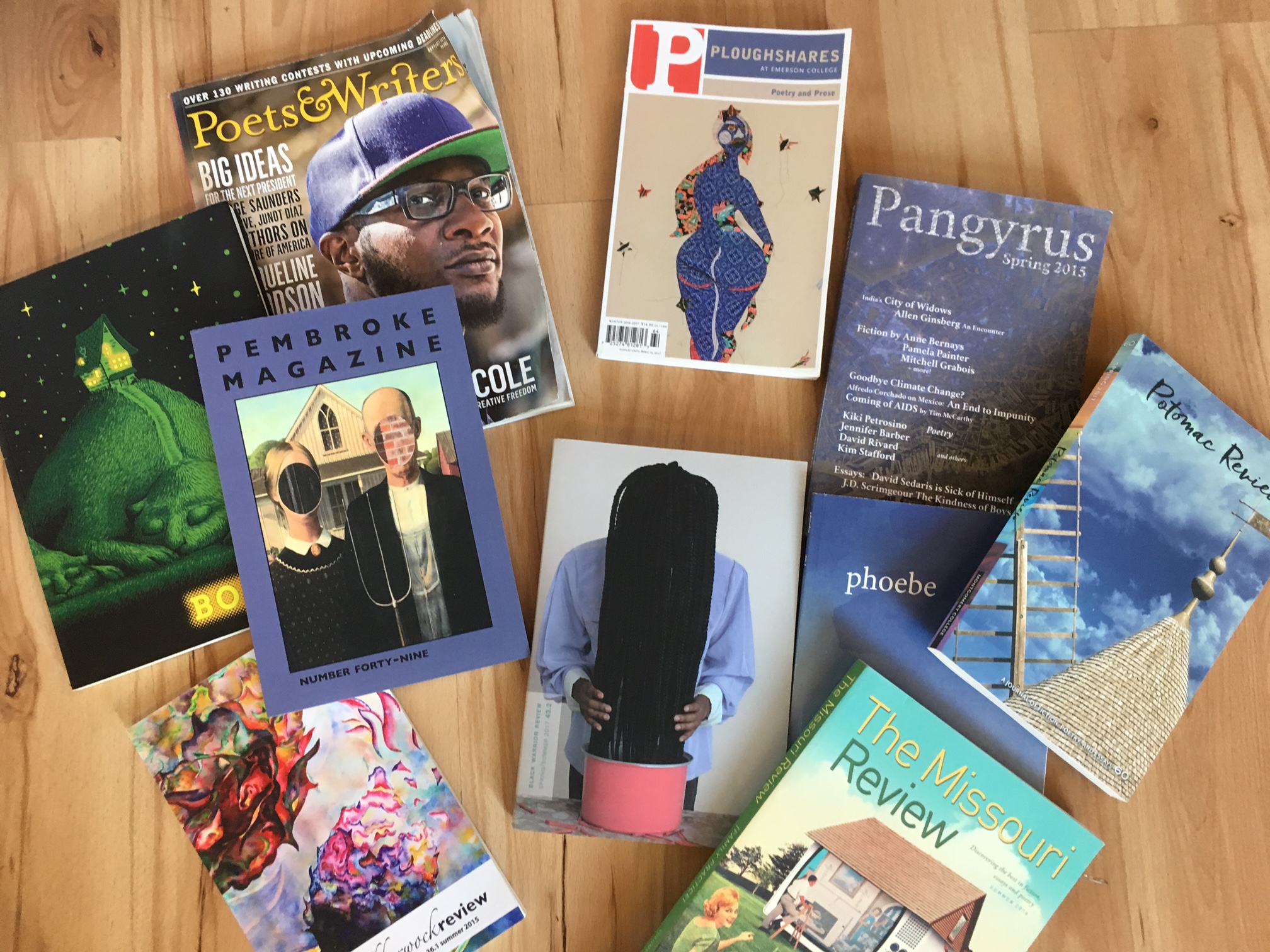
Lit Mag 2Most literary magazines submission guidelines tell you to read their magazine to see what kind of work they publish.

This can be daunting when you are struggling to find enough time to write, let alone publish.

Furthermore, when you follow their directions and do the reading, it’s hard to decide which magazines to read (there are so many!), and it’s hard to extract their aesthetic. Finally, magazines often have guest editors and their slush pile readers often rotate, so it is certainly not an exact science.

Nevertheless reading broadly is a good idea not just for other writers, but for you.  It speaks to the fundamental reason you (we) write. While many of us started to write out of need to hear ourselves, to witness, or to express ourselves, in the end, that can’t be the only impetus or result.  It’s like going to a party and monologuing. As satisfying as that might be short term, we are social animals who need to be part of a larger community conversation.

Ultimately, we write as a way of interacting with the world, and reading is an important give and take in that interaction.

So, where to start?  I recommend that you go to Poets and Writers’ website, http://www.pw.org, scroll down to “Tools for Writers” and click on Literary Magazines. This is not an exhaustive list,and not all the magazines listed will survive or be well known, but it’s an easy way to browse.  You can also Google “Top literary magazines” and get a good list of the most famous ones– the ones that if you get published there will help others taken you more seriously by publishers.

Also, explore some of the many, amazing independent presses. Check out “25 Independent Presses That Prove this is the Golden Age of Indie Publishing.”

Remember, as the editor of Bellevue Literary Press said (publisher of the Pulitzer Prize winning novel, Tinkers by Paul Harding, if you’re not buying, no one is (especially if Trump has his way and defunds the National Endowment for the Arts and the National Endowment for the Humanities).

With this in mind, I’m starting new Quick Take series. I’ll spot-read issues of various literary magazines and presses that come across my radar, and I’ll write short reviews of pieces which exemplify that magazine’s or press’s aesthetic.

See you around, soon.


Advice, Humor, Tools of the Trade

Hook Them With Your Opening Line, but. . .What I Learned at the GrubStreet Shop Talk Happy Hour

opening linesI was late to the GrubStreet Shop Talk Happy Hour, for which I had paid $75 to talk with an agent and editor. Dan Loedel, a lanky young man with a goatee and black-rimmed glasses, who works for Scribner, scooted over to the black window bench to make room for me. I introduced myself and tried my “pitch” on him: “After her mother spontaneously combusted on the Altiplano between Bolivia and Chile, Fallon struggles to make to grasp her identity and reality. Fifteen years later, her brother, who is bi-polar,” I could hear him sigh at this point, but I pressed on.
He sat back and wrinkled his nose. “Your pitch is too plotty. As an editor of literary fiction, I’m less interested in plot and more interested in language and style. What are your “comparables?” That’s shoptalk for authors you might compare yourself to.

I suggested magical realists like Aimee Bender and Karen Russell. That was strike two.

“People in the publishing industry don’t call Karen Russell’s or Aimee Bender’s writing magical realism.”

“What would you call it?” I asked.

He thought for a moment. “I’d call it literary fiction that pushes the boundaries of reality.”

Okay, I admit it. I was discouraged. I was hoping people would say, “Wow, fascinating, send it to me” or “Sounds original, ground breaking, Pulitzer Prize winning.” After all, little grandiosity goes a long way towards getting a person to stick to a project for many years.

Part way through the happy hour we were supposed to mingle. Dan introduced me to an editor from William Morrow, and she agreed. She said, “spontaneous combustion” raised so many questions about whether I was I or joking, talking about reality or metaphor, that she couldn’t listen to the rest of the pitch. She thought I should simply say, “After the mysterious death of her mother . . .”

My friends all groaned when I told them this later.  They love that opening line.

But later, at the GrubStreet Manuscript Mart, where agents and editors read the first 20 pages of you manuscript and comment, Laura Biagi from the Jean V. Naggar Agency agreed that I should start with something less confusing, or go into more detail about the combustion,  or start in real time in the present with the main character and give us enough about her that we start to really care about her.  Here’s the former first paragraph:

          After her mother spontaneously combusted on the altiplano between Chile and Bolivia, Fallon turned her head, saw herself reflected, beautiful and male, in the face of her older brother Ovid and fell in love. Fifteen years later, navigating her way across the crowded floor of the North Star Pub to serve drinks to tourists and Wall Street brokers, she was still struggling to disentangle herself from both events.

         Ovid had called her again yesterday.

I told her I was making a bow to the opening line of Gabriel Garcia Marquez’ novel, One Hundred Years of Solitude, “Many years later, as he faced the firing squad, Colonel Aureliano Buendía was to remember that distant afternoon when his father took him to discover ice.”  She pointed out that the his novel then goes into that scene of the discovery of ice, whereas my first paragraph starts in the past, brings us too briefly to the pub and then goes the previous day.  Too much too fast.

I’ve been hanging out with poets too much, damn it, who like compressed language, and I’ve been writing a lot of short stories where things have to happen fast. But in a novel, apparently, we need to start a little slower.

Peter Blackstone from Grove also agreed that my first paragraph was front loading the novel too much.

So, I learned a valuable lesson. Start your novel with a hook but don’t give people whiplash.

Course, a friend of mine who works for GrubStreet would say, “You’ve also learned that the big publishers aren’t adventurous.” They say they want something different, but not that different. After all, it has to be something that 100,000 people would like. He had personally given up on them, claiming that the best work is coming out of small presses. I can attest to the small press and magazine exuberance and inventiveness at the AWP (Associated Writers and Writing Programs) bookfair.

But if you want to quit your day job so that you can write more, you have to please the big publishers.

I’ve vowed to give it a shot. Then I’m going to the small presses.


Advice, Writing Prompts

Metaphor Writing Prompt 2

Jonquils_and_English_Leaves (1)Here’s a prompt I got from Discovering the Writer Within: 40 Days to More Imaginative Writing by Bruce Ballenger and Barry Lane.  It won’t generate a poem or a whole piece like my synesthesia exercise, but it will produce a clever line or two for an essay. I don’t make a big distinction between similes and metaphors in this exercise, though I think they have different emotional impacts. (Metaphors, without the inter-mediation of the word “like” are more immediate, atmospheric and magical, hence better for stories of that nature. Similes are better for essays, but work fine in stories, too.)

Step 1: Put a line down the center of your page and fold in half.Then write down a random list of abstract concepts.  Then flip the page over and write down an equally random list of concrete things that you can see, taste, touch, hear or feel (try not write things that relate easily to the first list). Like so:

Abstract/General Concrete/Physical
Love

War

Peace

Prejudice

People

Nature

Cayenne Pepper

Marshmallow

Dirty sneaker

Swamp

Rust

Bitter cucumber tip

Step 2: Next, fill in the blanks of this sentence below  using one word from the abstract side and one word from the concrete side.

____(abstract noun)_________ is (like)____(concrete noun)__________.

When you do this, don’t pick things that match — pick something that seems oddly mismatched or is truly random.  This is important, because metaphors have more power when they take big leaps. If the leap is too small, there’s no snap. If the leap is too big, it’s called a conceit (which is a no-no for some — but I’m not a big nay-sayer).

Step 3: Now write a sentence that helps to explain.

For example:

  • Love is like cayenne pepper.  A little bit goes a long way.

Here’s one a student wrote years ago:

  • Love is like going to the moon.  It takes a long time to get there, but when you do, the earth looks very different.

Give it a try and have fun. Please feel free to reply with surprising outcomes.


Advice, Magical Realism, Updates

Spontaneous Combustion, Music, and other forms of Play

Karen Russell

After her mother spontaneously combusted on the altiplano between Chile and Bolivia, Fallon turned her head, saw herself reflected, beautiful and male, in the face of her older brother Ovid and fell in love.

This is the opening line of my novel-in-progress The Ciphery, where the main character tries to figure out how a person can ever trust herself in a world where reality is a matter of perception and the improbable has already occurred. I hear the opening line to the tune of Pink Martini’s “Le Premier Bonheur Du Jour”.

In a former post, I said I would periodically post links to music from the playlist Ciphery theme music. Though I understand that many write while listening to music, I can’t actually do it for long, because hearing is my dominant mode of information processing, and my attention goes to anything audible first. However, music is a quick way to get back in touch with where one has left off, while it pleasantly promotes theme and tone continuity.

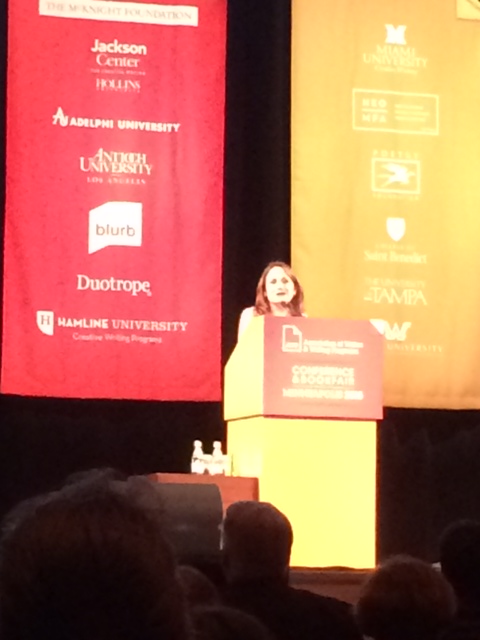
As I write this post, I’m at the Associated Writers and Writing Program Conference 2015 in Minneapolis, MN. Just listened to Karen Russell’s keynote address, “The Paradoxical Usefulness of Non-Utilitarian Motion AKA Play.” It was far too brilliant for me to absorb every word (especially after getting up at 3:30 to catch a plane to Minneapolis and listening to sessions all day), but the gist of it was that play – which by definition has no purpose and is done for its own sake– has a transcendent, revolutionary, and healing purpose. And that’s what we writers do.

She gave an example of how stroke victims heal more by trying to simulate the motions of a virtual dolphin than by repetitive goal-oriented movement. The seemingly random motions of a flailing baby wire our brains for language, and the air-bubble rings that dolphins make, for no other purpose than to have fun, distinguish them as having superior intelligence. She said play is the seedbed of all language and that it can’t be reduced to its effects, hence the paradox. We play to play, which makes us better writers. And, I might add, as soon as we play to get better at writing, we cease to play.

She said much more, but that’s all I’ve got for now. I’ll post a link to the written version, if she posts it.

I also attended a GREAT panel called, “Nerd Novels: Exploring Worlds of Knowledge in Fiction,” led by Peter Mountford, Jean Hegland, Michael Byers and Susan Gaines and another great session on the uncanny with Kelly Link, Steve Stern and Karen Russel, where I became aware of the magical realist oriented Small Beer Press, and I attended a session on why fairy tales continue to haunt us. More on all that in a future posts.

AWP was fab as always. The bookfair reminds you that the creativity thrives under the radar of “the market.”

XO to everyone!